Friday, February 24, 2012

How to Turn an Obstacle into an Asset

A popular post on this site, Nine Things Successful People Do Differently, provides a fabulous summary of what makes the difference between those who succeed and those who don't. But, in our experience, it misses one really important "thing': Successful people habitually turn obstacles into assets.

People who succeed at work and in life believe and act as if "everything is a gift." Well, maybe not every single thing imaginable. But assuming that everything is a gift is a good way of looking at the problems and surprises you'll encounter in any endeavor, such as, for example, in getting a new venture off the ground, obtaining buy-in with your boss, or launching a new product line in an ultra-competitive market.

Why should you react to a problem with gratitude, whether you are trying to start a business or create anything else? There are a number of reasons.

First, you were going to find out eventually what people did and did not like about your idea. Better to learn it as soon as possible, before you sink more resources into the idea, venture or product line, etc.

Second, the feedback could take you in another direction, or serve as a barrier to your competitors. You thought you wanted to open a restaurant, but a quick survey told you potential customers thought the area was saturated. But more than a few of them said they would love a place that simply had ready-to-go take out to heat up at home.

Third, you got evidence. True, it was not what you were expecting or even wanted, but that still puts you ahead of the person who is just thinking about doing something (like opening a restaurant in your neighborhood.) You know something they don't, and that is an asset. You are ahead of the game.

But what if it's really bad news. It's a disappointment. You were absolutely certain that your boss would approve your idea for a new software program, and she said no in a way that is still echoing down the corridor. No reasonable person can define what you've encountered as anything but a problem, and most people will try to solve the problem. ("Maybe she will like the idea if I go at it this way instead.") That's fine if you can. The problem has gone away and, again, you've learned something that others might not know. (The boss hates Y, but she loves Z.)

But what if you can't solve it? (She hated "Z," too.) Accept the situation to the point of embracing it. Take as a given that it won't ever change, and turn it into an asset. What can you do with the "fact" that it won't ever change? Maybe it presents a heretofore unseen opportunity. Maybe you build it into your product or service in a way that no competitor (having not acted) could imagine. Could you do it on your own? Could you take the idea to a competitor and use it as your calling card to look for the next job? Instead of resisting and lamenting it, treat it as a gift and turn it to your advantage.

For a quick exercise showing that this is easier than you think, take a sheet of paper and divide it into three columns. In the left-hand column, list the obstacles and problems that are keeping you from your goal. Then spend five minutes figuring out as many ways as possible to solve these problems, and list those in the middle column. Show your list of problems and solutions to a friend, and ask them to build on your solutions. When you can't think of anymore solutions, go back to the list of problems in the left-hand column and assume that they can't ever be solved. Now take five minutes with your friend and figure out how those problems could be an asset or an unrecognized opportunity. Put these assets in the right-hand column. Chances are good that, having completed this exercise, you'll turn at least one of your obstacles into an asset.

The thing to remember is this: Successful people work with what they have at hand — whatever comes along — and try to use everything at their disposal in achieving their goals. And that is why they are grateful for surprises, obstacles, and even disappointments. It gives them more information and resources to draw upon.

Posted via email from Local Andy

Thursday, February 23, 2012

Packers help lead Green Bay into Digital

%22+width%3D

The football season was looking great for the Green Bay Packers. The 2011 Super Bowl champions finished the regular season with 15 wins and one loss, only to lose in the playoffs last month to this year’s Super Bowl champions the New York Giants.

Many tears were shed in Titletown, but likely not too many among Green Bay’s biggest digital media players. True they would have profited from a Super Bowl bout — Gannett-owned local newspaper Green Bay Press Gazette’s website, GreenBayPressGazette.com, and its micro site PackersNews.com, had 6 million more page views in January 2011 than in the year prior period. But the sheer presence of a major NFL franchise in Green Bay, Wis., has been a big win for digital advertising providers playing in a market of its size.

Story continues after the ad

In terms of population, the Green Bay-Appleton market is the 69th largest DMA in the country, according to Nielsen. But in terms of digital spending, it actually ranks at No. 58, fueled by a strong league of Packer-backers, digital ad-embracing recreational businesses, as well as a solid auto dealer market. For the Gannett-owned Press Gazette, digital advertising actually makes up nearly 20% of its overall ad revenue, said Advertising Manager James Maurer.

“Being in a small market with a national football franchise gives us a different flavor,” suggested Dana VanDen Heuvel, president of Green Bay-based digital marketing consultancy Marketing Savant. “We’re obviously smaller, but at the end of the day there’s a little innovation going on and opportunity to experiment.”

The digital advertising market as a whole is above the curve in Green Bay, but some areas are still behind. Most noticeably, spending share in Green Bay towards streaming video ads is 4.6% less compared to the national average (the fact that only two local TV news players dominate the online media market could be a factor, Larry Shaw, VP of research for Borrell Associates, suggested).

Yet Green Bay is excelling in terms of behavioral targeting, with a local share of spending 4.3% higher than the national average. At $9.2 million in 2011, spending is expected to reach $89.4 million in 2016, a significant 868.2% increase.

“The Green Bay market is more focused on local advertisers,” Shaw said. “The smaller business market can afford to do that targeted ad instead of the old method of advertising. A local restaurant doesn’t want to reach as many people as possible, it wants to reach as many people in the area that are likely to go to the restaurant.”

According to comScore, the Press Gazette is the area’s digital media champion, scoring a monthly average of 429,500 unique visitors for the year period ending December 2011.

Only two other media players in the market reach comScore’s minimum reporting threshold of 50,000 unique visitors a month, said comScore marketing manager Carmela Aquino.

Fox affiliate WLUK-TV, owned by LIN Television, is at No. 2 with 355,117 average unique visitors a month to its site Fox11Online.com for the year ending last December. Jay Zollar, WLUK’s VP and GM, gives some credit to the station’s “balanced news” brand, directly inspired by cable news leader Fox News.

Coming in third is WBAY-TV, a local ABC affiliate owned by Young Broadcasting.

WBAY.com received a monthly average of 223,500 unique visitors for the 10-month period ending last December. (Aquino explained that WBAY used a different reporting methodology for December 2010 and January 2011, so numbers for those months are not comparable. In that same 10-month period, the Press Gazette averaged 428,100 unique monthly visitors and WLUK averaged 353,800 unique monthly visitors.)

The Press Gazette’s site-defining Packers coverage welcomed some digital enhancements for the team’s Super Bowl-winning season. During the playoffs, the Packers’ site featured daily live chats with team reporters, and the entire newsroom contributed to blog about Packer-related happenings in town, such as a local elementary school where students and teachers wore green and gold for the day, said Online Editor Julie Riebe.

For the most recent season, the site posted several videos a week of news conferences and locker room interviews, generating several thousand views each. It also ramped up efforts on an ongoing historic photo gallery project; approximately 2,000 to 2,500 Press Gazette archived photos were preserved and showcased on the site last season, with one gallery alone generating 221,000 page views, Riebe said.

The Press Gazette’s mobile sites underwent a Gannett-designed overhaul in February 2011. “Before they weren’t really that attractive,” Riebe said of the old mobile sites. “Now they’re cleaner, and they’ve made it easier to find features like weather and sports scores, and we’re able to add photo galleries to the mobile sites.”

The sites are also customizable; as an example, the Press Gazette put together a University of Wisconsin sports tab exclusive to its mobile sites. Five months later, Gannett modified the Green Bay sites to resemble the Odyssey template it has rolled out for other properties. “It was an effort to make the sites look cleaner to the reader, to present stories in a better format and to give more presence to photo galleries,” Riebe said.

Posted via email from Local Andy

Wednesday, February 22, 2012

Brands Get Physical To Build Trust

From Fast Company -

From handshakes to hardware, intimate signals constantly affect us in life. As the world becomes increasingly digital, we are losing many sensory signals that once moved us. Here's what can companies do to reclaim these touching moments.


I’m sure you’ve had the experience of reaching out to shake someone’s hand, only to be surprised by a palm so limp that it feels more like a dead fish than a warm welcome. What was your immediate impression of the person? How, then, did you reassess them? If you thought it indicative of a weak character, you’re onto something.

Some years ago, researchers at the University of Alabama studied 112 male and female students whose handshakes were evaluated by four handshake coders. The coders had received one month of training and practice in shaking hands and evaluating handshakes before the study began. The students, who didn't know their handshakes were being evaluated, had their hands shaken eight times (twice with all four experimenters) and they also completed four personality questionnaires.

Results of the study, led by Dr. William F. Chaplin, showed that a person's handshake is consistent over time and is related to some aspects of his or her personality. Those with a firm handshake were more extroverted and open to experience, and less neurotic and shy than those with a less firm or limp handshake. What strikes me is that we are somehow intuitively aware of this personality evaluation filter, where something as simple as a touch significantly influences our decision-making processes.

Having worked with sensory signals throughout my career, I’ve come to appreciate how the smallest sensory details can have the greatest impact. Take, for example, the sound and feel of opening a bottle of water. You’re at least subconsciously familiar with the subtle click of a breaking seal. However, let’s say you’re in India, where the water bottles open silently. When I heard about the absence of the subtle click, I questioned the safety of the water. Apparently I wasn't alone: I remember reading about a competitive water bottler who took advantage of this, changed the top so that it clicks, and gained a competitive advantage in the water market place. People believe the water is safer.

Signals across almost every aspect of our lives affect us. It’s interesting to note that, as we become increasingly digital, we are losing many sensory signals that once surrounded us. Others, however, often replace these. We’ve come to depend on a whole new set of tones as we key in numbers on an ATM or a cell phone.

In order to investigate just how important our senses are, I initiated a small experiment exploring people’s perception of an unknown brand, based on the type of media where they were introduced to it. I wanted to look at how different media formats convey indirect messages. But, most importantly, I was interested in seeing if the physical presence of a media channel, such as a billboard, would affect a person’s sensory impression of the advertised brand.

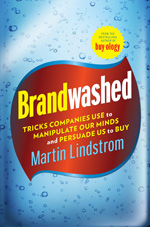
Martin Lindstrom is a 2009 recipient of TIME Magazine's "World's 100 Most Influential People" and author of Buyology: Truth and Lies About Why We Buy (Doubleday, New York), a New York Times and Wall Street Journal best–seller. His latest book, Brandwashed: Tricks Companies Use to Manipulate Our Minds and Persuade Us to Buy, was published in September. A frequent advisor to heads of numerous Fortune 100 companies, Lindstrom has also authored 5 best-sellers translated into 30 languages. More at martinlindstrom.com.

Posted via email from Local Andy

Monday, February 20, 2012

The Legal Implications of Turning Advertisers Into Content Makers

Street Legal http://streetfightmag.com/?p=15259">0 Comments 20 February 2012 by Brian Dengler “Advertising is content — the only new content that really matters,” wrote AR&D‘s Terry Heaton in a recent blog post responding to a Pew report that questions the financial future of news. His point is salient, for sure, and it renews the question of whether hyperlocals should be incorporating content created by local merchants — perhaps in the form of advertorials or “guest columns.” Publishers like StarNewsOnline are giving it a try. Pulling it off successfully, however, requires hyperlocals to make sure they don’t turn a revenue opportunity into a regulatory nightmare.Heaton suggests that one remedy for local media is to acknowledge that “advertisers are the new content makers, and we need to be exploiting our strengths as experts in the world of content creation in order to serve this burgeoning market.” In a Street Fight column published last year, Patrick Kitano suggested this was just the formula: “Simply put,” Kitano wrote, “business is integral to engaging the community, because they have the commercial incentive to create content that builds their brand equity, directly or indirectly. In the world of social media, the local foodie reporters own restaurants, and the real estate bloggers are realtors; their voices are part of the local media landscape but generally segregated from local news media.”A new research report released by the Content Marketing Institute disclosed that marketers use articles as a leading tactic for B2B marketing. In fact, articles make up 79% of B2B marketing strategies according to the study. Clearly, taking content from merchants is a ripe opportunity for publishers. Patrick Williams, publisher of Worth Magazine, estimated in January 2010 that the magazine’s advertorial program would account for 50 to 60 percent of the magazine’s revenue “in the near future.”However, advertorials and “guest editorials” cannot be passed off as standard editorial content. Two years ago, the FTC issued new guides governing testimonial advertisements, bloggers and celebrity endorsement. The FTC Guides require that a publisher disclose whether content posted on an editorial site or blog was sponsored, paid for, subsidized, or prepared by an advertiser or merchant. For example, the guidelines require:If you run an advertorial for a local business, such as yoga class, you must disclose that the content is a paid advertisement.If you obtain free services or a free sample to write a review for a local shop, you must disclose to the reader that you were provided the sample to write the review.If you are offered a free meal at a local restaurant to write a review, you must disclose the fact in your review.You must disclose if any of your writers or bloggers are sponsored by a particular advertiser or merchant.Your independent writers and bloggers must disclose if they were paid to provide an article or review.The consequences for lack of transparency can be severe. In March 2011, Legacy Learning of Nashville, Tenn., agreed to pay the FTC a $250,000 fine to settle charges that it deceptively advertised its products through online affiliate marketers who falsely posed as ordinary consumers or independent reviewers on various blogs. The company sold a series of guitar-lesson DVDs. It used an online affiliate program, through which it recruited “Review Ad” affiliates to promote its courses through endorsements in articles, blog posts, and other online editorial material. The affiliate sites never disclosed that Legacy Learning paid for the affiliates to post the content.Even if hyperlocals are not directly paid or sponsored to run a “guest column” by a local merchant, the FTC Guides may require disclose about the advertorial nature of the article. The “guest columnist” likely is an employee, owner, or a writer paid by the merchant to write the article, whose economic interest may directly, or subtly, motive the nature of the article.Hyperlocal publishers such as StarNewsOnline.com of Wilmington, N.C., provide an effective example of using “guest columnists” for advertorials that may avoid regulatory scrutiny. The StarNewsOnline publishes guest articles prepared by restaurateurs, who may write about their menus or other topics of human interest about their guests. Although appearing in most respects as a standard story, the articles’ headlines are clearly — and boldly — labeled as advertorials. Thus, as long as hyperlocals are transparent about the advertorial nature of some content, hyperlocals can benefit from a source for content, a community connection, a community story, and potential revenue opportunities.Brian Dengler is an attorney with Vorys Legal Counsel and journalist who covers legal issues in eMedia. He is a former vice-president of AOL, Inc., a former newspaperman, and an EMMY-winning TV journalist. He teaches new media issues as an adjunct at Kent State University and formerly at Otterbein University.via streetfightmag.com

Posted via email from Local Andy

Friday, February 17, 2012

Mobile business models that work – Feb 21st, 6:30PM, Santa Monica

Mobile business models that work – Feb 21st, 6:30PM, Santa Monica

LAVA Mobile presents an inspection of mobile business models from three thought leaders within the local mobile community.  The event will be a panel session featuring Andy Vogel (Tribune Company), Shuki Lehavi (Gumiyo) and Peter Marx (Qualcomm), moderated by Lori Kozlowski (former LA Times journalist).  The group will be examining the current trends in mobile business models – what works, what doesn’t and what is over the horizon.
  • What are some unsolved business problems that mobile might solve?
  • Where in the mobile space are businesses beginning to generate new or incremental revenue? 
  • What are they doing?
  • All our panelists are touching the local SMB space in some way. 
  • What are the problems there, from a service provider and advertiser perspective and how can mobile solutions solve those?
  • What’s missing in the mobile ecosystem that is hindering success for some business models?  Point-of-sale technology for mobile coupon redemption, for instance.
  • What technology is missing?
  • The first meeting of the Los Angeles Venture Association Mobile Strategic Information Group is open for registration.   Tuesday, February 21, 2012, 6:30pm -8:30pm, Working Village, 212 Marine Street #100,  Santa Monica, CA 90405.  Register at the LAVA website. LAVA Members and their guests attend free; $25 for non-LAVA members.

    We are looking forward to a great evening of information sharing, networking and the formal launch of LAVA Mobile for LAVA members and the general business community of Los Angeles.  LAVA Mobile and this inaugural event are generously sponsored by Ernst &Young.

    Posted via email from Local Andy

    Tuesday, February 14, 2012

    MMA rolls out new services to help marketers standardize mobile advertising

    From Mobile Marketer
    Millennial Media
    Millennial Media's mobile ads for VeeV

    The Mobile Marketing Association has made additions to its mobile advertising packages aimed to make it easier for marketers to buy, sell and create mobile ad campaigns.

    The additions are part of the second version of the MMA Universal Mobile Ad Package. After researching impressions from the second quarter of 2011, six mobile ad units will be the standard for mobile marketers.

    “The guidelines are meant to reduce the friction for agencies, publishers and ad networks,” said Greg Stuart, global CEO of MMA Global, New York.
     
    “As an industry, we believe this is what we should use,” he said.

    The MMA is a non-profit trade organization that helps mobile marketers establish guidelines and standards to overcome obstacles in the industry.

    Ads on mobile
    The MMA created two documents in 2011 that were meant to help marketers understand the mobile advertising market. However, with the explosion of mobile advertising over the past year, the organization has developed new standards that help marketers establish more specific guidelines for campaigns.

    In order to create the new standards, the MMA worked with its members in mobile ad networks, agencies, publishers and rich media vendors and looked at 150 billion ad impressions.

    The six new mobile ad formats are using data to drive the new standards with the goal of helping marketers get tangible results from their mobile campaigns.

    Three of the new standards are based around smartphones. The other three target feature phone users and are intended at creating standards for mobile Web.

    In order to be compliant, ad networks and publishers must agree to incorporate the new sizes with the goal of eventually standardizing all mobile ad sizes.

    Ad networks and publishers have until April to become compliant. If they abide by the guidelines, they will be promoted by the MMA and can place stamps on their marketing materials and Web sites.

    For feature phones, the three sizes of mobile ads are 120 by 20 pixels, 168 by 28 pixels and 216 by 36 pixels.
    Given the size and user interaction of smartphones, the sizes of ads are slightly bigger. Three hundred by 250 pixels, 300 by 50 pixels and 320 by 50 pixels are all acceptable.

    Additionally, audio components to mobile ads are set at 15 seconds, showing how mobile can be effective for letting consumers interact with pieces of multimedia, but it is best used with short messages.
    Guidelines for mobile video and rich media are not included in the new ad standards.

    Eventually, the standards will be rolled out across the world.

    Tablet guidelines
    With the growing number of tablets and device-tailored campaigns, the MMA’s new guidelines help mobile marketers use tablet-specific standards for mobile advertising.

    The guidelines are primarily based around the iPad device, but the organization will be giving new guidelines every six to nine months to help mobile marketers navigate the tablet space.

    The four main dimensions for tablet advertising being used today are 300 by 250 pixels, 468 by 60 pixels, 728 by 90 pixels and 1024 by 90 pixels.

    The tablet-specific standards also use research from the IAB, which suggests 160 by 600 pixels and 300 by 600 pixels for mobile Web accessed via tablets.

    The guidelines are less specific than the smartphone guidelines, showing how new tablets are still a piece of unknown territory to the space.

    “We are trying to give guidance to publishers to move them in the right direction with tablet advertising, but still keep the door open with standards,” Mr. Stuart said.

    “The MMA’s job is to step aggressively into the mobile industry and create appropriate standards for the industry,” he said.
    “Everything is geared towards accelerating the growth of mobile.”

    Final Take

    Lauren Johnson is editorial assistant on Mobile Marketer, New York
    Lauren Johnson is editorial assistant on Mobile Marketer. Reach her at lauren@mobilemarketer.com.

    Posted via email from Local Andy