Monday, August 27, 2012

The value of homepages is shifting from traffic-driver to brand

At leading media companies, like The New York Times and The Wall Street Journal, the majority of traffic now bypasses the homepage.
Moving on from newspapers, journalism industry soothsayers are now predicting the decline of something much younger: the homepage.
As with newspapers — which haven’t so much disappeared as been pushed off center stage — few are saying that homepages will disappear completely. But as more people enter news sites sideways — via search engines, links they see in emails, or via Facebook and Twitter — newsrooms are finding their homepages aren’t the starting points they once were. And the propulsive growth of mobile devices has accustomed news sites to presenting more than one face to the digital audience, through some mix of mobile-optimized sites, native apps, and responsive design. (You now have news outlets talking about their desktop sites almost as an afterthought to mobile-first development.)
(I’m willing to bet that you got to this very article through some non-homepage channel; less than 7 percent of visits to Nieman Lab start on our homepage.)
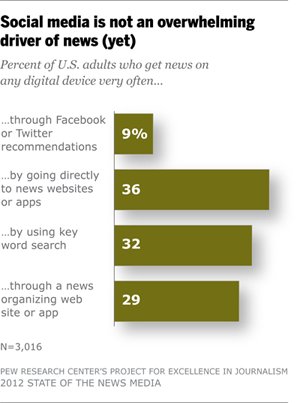
At the same time, traffic patterns seem quite divided between those who dive deep into social media and those who still head for news orgs’ front doors. Just 9 percent of Americans reported getting news through Facebook or Twitter “very often,” according to the Pew Research Center’s Project for Excellence in Journalism’s 2012 State of the News Media Report.
Earlier this summer, we reached out to a number of news organizations to see what they’ve been seeing in recent months. Take The New York Times, for instance. In early 2011, the Times was typically seeing 50 to 60 percent of its visits come from people starting at the homepage of nytimes.com. More recently, that number had dropped a bit, with 48.6 percent of site visits starting there in March. Search engines drove 17.1 percent of traffic to the newspaper, and social is still just a blip: 3.1 percent of New York Times traffic came from Facebook, and 1 percent from Twitter.

....More from Nieman Journalism Lab

Tuesday, August 14, 2012

Groovideo Launches Mobile App To Easily Create Awesome Group Videos

http://techcrunch.com/2012/08/13/groovideo/

Ryan Lawler on TechCrunch

groovideo
The mobile video space is heating up, as a number of startups have launched to help users create and share interesting videos with one another. To date, most have been limited to individual users uploading videos and posting them to other social networks like Twitter and Facebook. Maybe they can add filters, maybe automatically edit their videos and stitch them. But the idea of “social” video has been mostly limited to “Here, social friends and followers — watch my video.”

Groovideo has a different idea for how to make videos social, by letting users create awesome content together through its mobile and web apps. Groovideo works like this: Users invite their friends to contribute to videos, each shoot their own short clips, which they upload to Groovideo’s servers, and the startup automatically stitches them all together.
More on TechCrunch

Thursday, August 2, 2012

Magid Research: Smartphones, Tablets Firmly Established As Mainstream Devices; Growth Remains Rapid


The latest large-scale national study from Frank N. Magid Associates looks at key mobile trends, behaviors, and activities. It shows that a majority of all mobile consumers and 76% of those under 44 now own smartphones. More important, these devices are becoming the preferred way of accessing a wide variety of content including social media, news, weather, gaming, and video — including full-length TV and movies.

“There’s no such thing as distinct mobile content anymore,” said Tom Godfrey, Magid’s executive director of mobile strategy. “What publishers and advertisers have to realize is that a majority of all ‘Web’ content in the next 12 to 18 months will be consumed on a mobile device — and that it must be accessible and optimized.”
 

Tribune sponsored a robust section on consumer attitudes and behavior in local media and has made it available for free download to I-Facts subscribers. This section finds that local publishers are well positioned to gain tablet owners’ trust. Consumers prefer local news sources to national ones by a 2-to-1 margin overall, and local has a 3-to-1 advantage on specific criteria as credibility, reliability, and timeliness.

Andy Vogel, senior vice president for digital and mobile with Tribune Co., said: “When it comes to content, consumers trust local news sources, and that that trust rubs off to local advertisers as well.”


Download your copy at http://magid.com/magid-mobile-study  

The full report is $6500 and includes a customized in-person presentation.

For additional questions or to purchase, please contact Tom Godfrey at tgodfrey@magid.com