via netnewscheck.com
Wednesday, December 26, 2012


Tuesday, December 18, 2012
Instagram Privacy Changes Could Surprise Some Users
New details on Instagram’s revised Terms of Use suggest Instagram may start pulling user photos and incorporating them into ads — without pay.
According to the Terms that take effect on January 16, Instagram says that some parts of their photo-sharing service might be supported by advertisers. Sounds straightforward enough until their next statement:
"To help us deliver interesting paid or sponsored content or promotions, you agree that a business or other entity may pay us to display your username, likeness, photos (along with any associated metadata), and/or actions you take, in connection with paid or sponsored content or promotions, without any compensation to you."
Instagram Privacy Changes Could Surprise Some Users
New details on Instagram’s revised Terms of Use suggest Instagram may start pulling user photos and incorporating them into ads — without pay.
According to the Terms that take effect on January 16, Instagram says that some parts of their photo-sharing service might be supported by advertisers. Sounds straightforward enough until their next statement:
"To help us deliver interesting paid or sponsored content or promotions, you agree that a business or other entity may pay us to display your username, likeness, photos (along with any associated metadata), and/or actions you take, in connection with paid or sponsored content or promotions, without any compensation to you."
Friday, November 30, 2012
Cars.com Releases New Auto Show Mobile App
Cars.com has introduced an all-new mobile app to help car shoppers navigate auto shows with the help of its experts. The app provides users with breaking news on new car introductions, must-see vehicles along with up-close vehicle photos and videos for the major 2012-2013 auto shows. "Our new auto show app gives car shoppers instant breaking news on new car launches as well as photos and videos from this year's auto shows," said Patrick Olsen, Cars.com's editor-in-chief. "Instead of waiting to research what they've seen at the show once they get home, car shoppers can read expert insights while they walk the auto show floor, and make sure they don't miss any must-see cars."
PR Newswire via Sacbee
Cars.com Releases New Auto Show Mobile App
Cars.com has introduced an all-new mobile app to help car shoppers navigate auto shows with the help of its experts. The app provides users with breaking news on new car introductions, must-see vehicles along with up-close vehicle photos and videos for the major 2012-2013 auto shows. "Our new auto show app gives car shoppers instant breaking news on new car launches as well as photos and videos from this year's auto shows," said Patrick Olsen, Cars.com's editor-in-chief. "Instead of waiting to research what they've seen at the show once they get home, car shoppers can read expert insights while they walk the auto show floor, and make sure they don't miss any must-see cars."
PR Newswire via Sacbee
Tuesday, November 27, 2012
Apple Reclaims Top Spot In U.S. Smartphone Sales
According to data from Kantar Worldpanel, the iOS operating system from Apple has reclaimed the lead in the U.S. smartphone sales race. In the 12 weeks ending on October 28, iOS claimed 48.1% of U.S. smartphone sales, compared with 46.7% share for the Android operating system from Google. Apple's U.S. success is not duplicated in Europe, where Android grabs a 73.9% share in Germany and an 81.7% share in Spain. Kantar notes that Windows Phone from Microsoft Corp. on Lumia handsets from Nokia Corp. nabs 11.7% of the smartphone market in Italy. Of U.S. iPhone 5 sales, 62% are owners of earlier iPhone models who are upgrading, 13% are switching from Android phones, and 6% are switching from BlackBerry phones from Research In Motion Ltd.
Daily Finance
Apple Insider
Monday, November 12, 2012
47% of National Brands Plan Increase in Local Marketing
Ninety-one percent of national brands expect to invest more or the same amount in local marketing heading into 2013, according to a new survey by local marketing firm Balihoo.
Of those surveyed, 47.3 percent of brands said they plan to invest more in local marketing for 2013 than they did in 2012. According to Balihoo numbers, much of that investment will go into mobile local marketing.
Over 34 percent of surveyed participants expect to use mobile as a major local marketing tactic in 2013. That number represents a slight increase from last year when only 32 percent of those surveyed said that mobile was a main tactic for their local marketing agenda.
While mobile tactics are expected to be up next year, local search registration and local website investment is expected to go down in 2013. Balihoo's research says that local search registration tactics usage will become less of a factor by almost 3 percent next year. While local website tactics will see a steep decline from 46 percent usage to about only 16 percent.
Wednesday, October 31, 2012
Sandy Took Down 25% of NYC Cell Towers
NEW YORK (AP) -- Superstorm Sandy knocked out a quarter of the cell towers in an area spreading across 10 states, and the situation could get worse, federal regulators said Tuesday.
Many cell towers that are still working are doing so with the help of generators and could run out of fuel before commercial power is restored, the Federal Communications Commission said.
Story continues after the ad
The landline phone network has held up better in the affected area, which stretches from Virginia to Massachusetts, the FCC said, but about a quarter of cable customers are also without service.
The FCC did not have an estimate for the number of people in the affected area.
Call centers for 911 service have held up relatively well, with only a few failures, according to FCC chairman Julius Genachowski. Calls to those centers are being rerouted, but operators may not be getting the automatic location information that 911 centers normally receive.
Sandy left widespread destruction, but the water welling into southern Manhattan drenched one of the world's densest communications nodes, taking out popular websites and forcing telecom carriers to reroute international traffic.
As commercial power was cut to the southern tip of Manhattan on Monday, data centers and facilities of phone companies in the Wall Street area were forced to switch to diesel generators. Data centers that failed to keep running on backup power brought down news and gossip sites Gawker, Huffington Post and many popular New York-based blogs.
Gawker was still down Tuesday afternoon, but Huffington Post was back online. Their webhost, Datagram Inc., said power was out and flooding in their basement was preventing their backup generators from pumping fuel. Internet connectivity from three providers was also down.
Verizon Communications Inc., the biggest phone company in the region, had some of its facilities in downtown Manhattan flooded, shutting down phone and Internet service.
Further uptown, data centers hosted in a "telecom hotel" that spans a whole block and houses Google's New York headquarters were reporting outages as well, apparently because backup power failed when commercial power was cut Monday evening.
Renesys Corp., which monitors the pathways of the Internet, said the storm caused major outages in New Jersey and New York. The city is a major transit point for international telecommunications traffic, and the firm said carriers were scrambling to route traffic around it.
Cablevision Systems Corp., which serves parts of Long Island, New York City and New Jersey, said it's experiencing widespread outages due to the loss of power. The company said it doesn't yet know the extent of outages in New Jersey, which bore the brunt of the storm.
Time Warner Cable Inc., the other big New York-area cable company, said it had no reports of significant damage to its network, but customers without power had no cable service.
AT&T Inc. said there are "issues" in hard-hit areas, and it's in the early stages of checking for damage and restoring service.
via netnewscheck.com
Tuesday, October 30, 2012
Hurricane Sandy tests mobile's mettle for always-on capability
From Mobile Marketer
With Hurricane Sandy leaving its mark on the East Coast of the United States, mobile is proving its mettle as an always-on medium.
Industry experts agree that news and weather mobile sites are likely to see the biggest impact. Additionally, marketers are making sure they are monitoring their mobile site performance to make sure it is up-to-par.
“Keynote is going to be watching mobile and Web site performance closely today and throughout the storm and the cleanup,” said Daniel C. Berkowitz, senior director of corporate communications at Keynote Systems Inc., San Mateo, CA. “We expect problems, but we won’t know until the storm actually makes landfall.
Monday, October 15, 2012
Wii Price Cut
Nintendo Cuts Wii Price To $130 In U.S.
Nintendo announced Monday that it is dropping the price of its Wii console to $130 in the U.S. as it prepares to sell the next-generation Wii U in a little over a month. The new offer shaves $20 off the previous Wii price. To sweeten the deal on the six-year-old console, Nintendo is offering a complete package — a black console, a Wii Remote Plus, Nunchuck controller, and two-game bundle of Wii Sports, and Wii Sports Resort. Both games are on the same disc. The Wii U, Nintendo’s new console, is due in stores on Nov. 18 and will have a 23-game mix of original and ported titles already on other consoles. These include “Assassin’s Creed III,” “New Super Mario Bros. U,” and “Call of Duty Black Ops II.”
Washington Post
Nintendo announced Monday that it is dropping the price of its Wii console to $130 in the U.S. as it prepares to sell the next-generation Wii U in a little over a month. The new offer shaves $20 off the previous Wii price. To sweeten the deal on the six-year-old console, Nintendo is offering a complete package — a black console, a Wii Remote Plus, Nunchuck controller, and two-game bundle of Wii Sports, and Wii Sports Resort. Both games are on the same disc. The Wii U, Nintendo’s new console, is due in stores on Nov. 18 and will have a 23-game mix of original and ported titles already on other consoles. These include “Assassin’s Creed III,” “New Super Mario Bros. U,” and “Call of Duty Black Ops II.”
Washington Post
Xbox Music Launched
Microsoft Launches Xbox Music Service
Microsoft Corp on Monday announced that Xbox Music, a digital music service to vie with Apple Inc's iTunes and Amazon.com Inc's Cloud Player, will be available for its Xbox game consoles on Tuesday. Xbox Music will offer access to a global catalog of about 30 million songs. The service will let consumers listen free to any song on computers and tablets running the latest version of its Windows software, as well as on the Xbox console. Microsoft will not initially limit how much music can be streamed, though that could change over time. The service will be expanded to Windows software-based computers and tablets, including the upcoming Surface tablet, from October 26, when Microsoft launches Windows 8. It will be expanded to phones shortly after that. The world's largest software maker has been trying for years to make the household living room an entertainment hub with its Xbox. More than 67 million units have been sold since 2005. About 18 months ago, the company realized that Xbox users were spending half to 60% of their time on entertainment services rather than video gaming, Xbox Music general manager Jerry Johnson said.
Reuters
New York Times
Microsoft Corp on Monday announced that Xbox Music, a digital music service to vie with Apple Inc's iTunes and Amazon.com Inc's Cloud Player, will be available for its Xbox game consoles on Tuesday. Xbox Music will offer access to a global catalog of about 30 million songs. The service will let consumers listen free to any song on computers and tablets running the latest version of its Windows software, as well as on the Xbox console. Microsoft will not initially limit how much music can be streamed, though that could change over time. The service will be expanded to Windows software-based computers and tablets, including the upcoming Surface tablet, from October 26, when Microsoft launches Windows 8. It will be expanded to phones shortly after that. The world's largest software maker has been trying for years to make the household living room an entertainment hub with its Xbox. More than 67 million units have been sold since 2005. About 18 months ago, the company realized that Xbox users were spending half to 60% of their time on entertainment services rather than video gaming, Xbox Music general manager Jerry Johnson said.
Reuters
New York Times
Friday, October 12, 2012
Owning News No Longer Sustainable
Andrew Miller, CEO of the Guardian Media Group, speaking at Guardian's Future of Digital Media event, said digital brings in 30% of GMG's revenue and that, while "digital is fantastic," he worried about the sustainability of the business: "It's a completely different place we're in now," Miller said. "News organizations 'owning' news just is no longer a sustainable business model."

via netnewscheck.com
Thursday, October 4, 2012
Ad Age: ‘Digital dimes are turning into mobile pennies’
by Jeff Sonderman Published Oct. 1, 2012 4:17 pm Updated Oct. 2, 2012 11:16 am
PEJ | Ad Age | IAB | Econsultancy
The Pew Project for Excellence in Journalism released the results of a significant study today on the state of mobile news consumption in America. Pew found that some people consume more news after acquiring tablets and that getting news is the second most popular activity on tablets behind emailing. It also sheds light on the difference between people who use apps vs. the Web to get their news.Poynter’s Rick Edmonds looks at the business implications: While tablet ownership doubled to 22 percent in the past year, those tablet owners don’t want to pay for content and they aren’t crazy about advertising either. That leads Rick to conclude that “bundled subscriptions are looking better than ever.”
Mobile ads don’t inspire hope
The state of mobile advertising is getting a lot of attention as well, as Advertising Week kicks off today in New York. Ad Age writer Jason Del Rey notes that desktop Web ads go for about $3.50 CPM on average, but mobile ads are fetching only 75 cents CPM.
If publishers once lamented that offline dollars turned into “digital dimes” as content and audiences moved to the Web, here’s what might be keeping them up at night: Digital dimes are turning into mobile pennies.

The "Pull" ad format is one of five "rising stars" the IAB is highlighting for the future of mobile ads.
There is some hope for the future of mobile ads. The industry-standard-setting Interactive Advertising Bureau is showcasing five innovative new mobile ad formats that leave Web banner ads in the dust. The ad formats are interactive and customized to suit mobile screens, and hopefully that premium quality could lead to higher revenue.
An analysis on the Econsultancy blog asks, can the mobile ad market “really overtake television, which still generates more than double the revenue produced by all Web advertising?” Patricio Robles points out four factors holding back mobile ads: Small screen sizes, questionable effectiveness, user annoyance and a glut of inventory.
Forbes Chief Product Officer Lewis DVorkin writes that the tricky transition to mobile is what keeps him up at night. He concludes “there is really no magic bullet for mobile success,” but there are helpful steps Forbes is taking now.
Politico Pro chooses Web over apps
One more notable development: Politico Pro has relaunched its website with a responsive design that adapts to smartphone and tablet screens. Editor-in-Chief Tim Grieve tells me Politico Pro plans to forgo native mobile or tablet apps, since its new adaptive website “seems to do about 95 percent of what an app would do, and it gives us the flexibility to innovate on the fly in a way that a series of apps wouldn’t.”
The new site loads quickly and adjusts fluidly, thanks to a concerted mobile-first design effort, CTO Ryan Mannion told me. Developers reduced the number of embedded images, limited external javascript calls for plugins and ads, prioritized the loading of content elements, and used a heavy dose of caching to make page loading “faster and cleaner,” he said. Worth a look.

Related: Nat Ives’ in-depth report on The Daily, and whether it has a future (Ad Age).
Correction: This post originally misspelled the name of Jason Del Rey.
Tags: Advertising, Mobile, Politico, Responsive design, Tablets, Web apps
Related Posts
via poynter.org
Ad Age: ‘Digital dimes are turning into mobile pennies’
PEJ | Ad Age | IAB | Econsultancy
The Pew Project for Excellence in Journalism released the results of a significant study today on the state of mobile news consumption in America. Pew found that some people consume more news after acquiring tablets and that getting news is the second most popular activity on tablets behind emailing. It also sheds light on the difference between people who use apps vs. the Web to get their news.Poynter’s Rick Edmonds looks at the business implications: While tablet ownership doubled to 22 percent in the past year, those tablet owners don’t want to pay for content and they aren’t crazy about advertising either. That leads Rick to conclude that “bundled subscriptions are looking better than ever.”
Mobile ads don’t inspire hope
The state of mobile advertising is getting a lot of attention as well, as Advertising Week kicks off today in New York. Ad Age writer Jason Del Rey notes that desktop Web ads go for about $3.50 CPM on average, but mobile ads are fetching only 75 cents CPM.
If publishers once lamented that offline dollars turned into “digital dimes” as content and audiences moved to the Web, here’s what might be keeping them up at night: Digital dimes are turning into mobile pennies.
The "Pull" ad format is one of five "rising stars" the IAB is highlighting for the future of mobile ads.
There is some hope for the future of mobile ads. The industry-standard-setting Interactive Advertising Bureau is showcasing five innovative new mobile ad formats that leave Web banner ads in the dust. The ad formats are interactive and customized to suit mobile screens, and hopefully that premium quality could lead to higher revenue.
An analysis on the Econsultancy blog asks, can the mobile ad market “really overtake television, which still generates more than double the revenue produced by all Web advertising?” Patricio Robles points out four factors holding back mobile ads: Small screen sizes, questionable effectiveness, user annoyance and a glut of inventory.
Forbes Chief Product Officer Lewis DVorkin writes that the tricky transition to mobile is what keeps him up at night. He concludes “there is really no magic bullet for mobile success,” but there are helpful steps Forbes is taking now.
Politico Pro chooses Web over apps
One more notable development: Politico Pro has relaunched its website with a responsive design that adapts to smartphone and tablet screens. Editor-in-Chief Tim Grieve tells me Politico Pro plans to forgo native mobile or tablet apps, since its new adaptive website “seems to do about 95 percent of what an app would do, and it gives us the flexibility to innovate on the fly in a way that a series of apps wouldn’t.”
The new site loads quickly and adjusts fluidly, thanks to a concerted mobile-first design effort, CTO Ryan Mannion told me. Developers reduced the number of embedded images, limited external javascript calls for plugins and ads, prioritized the loading of content elements, and used a heavy dose of caching to make page loading “faster and cleaner,” he said. Worth a look.
Related: Nat Ives’ in-depth report on The Daily, and whether it has a future (Ad Age).
Correction: This post originally misspelled the name of Jason Del Rey.
Tags: Advertising, Mobile, Politico, Responsive design, Tablets, Web apps
Related Posts
via poynter.org
Thursday, September 20, 2012
Why paywalls don’t mean better journalism
The “hamster wheel” fallacy: Why paywalls don’t mean better journalism
Some proponents of newspaper paywalls — including a columnist in the Columbia Journalism Review — argue that charging readers for content results in better journalism than the free and advertising-supported model used by many digital publishers. But the evidence for this assertion is dubious at best.
There are plenty of arguments for why a newspaper or other traditional media outlet might decide to implement a paywall — including a need for revenue to supplement declining print advertising, or a desire to form a stronger bond with its readers. But do paywalls automatically mean that you get better journalism? In other words, does a free and ad-supported model mean that the journalism you get is of lower quality, because of the “hamster wheel” effect? Dean Starkman makes that case in the Columbia Journalism Review, but his argument rests on some pretty flimsy ground. The reality is that the connection between journalistic quality and paywalls is not as concrete as he makes it seem.
In his CJR column, which is entitled “The hamster wheel vs. the quality imperative,” Starkman takes aim at Digital First Media — the newspaper chain run by John Paton, which recently petitioned the court to put its subsidiary Journal Register Co. into bankruptcy for the second time, as a way of dealing with legacy costs like printing agreements and underfunded pension plans. The first clue to where Starkman is going comes when he says Digital First’s name is a misnomer, because the journalistic practices it advocates “are now commonplace in American newsrooms,” a statement that seems like a bit of a stretch at best.
Being ad-supported does not equal cheap click-bait
Starkman goes on to say that the most distinctive thing about Digital First’s model isn’t the digital-first part, but rather the fact that the chain gives most of its content away for nothing (although the company actually owns a number of papers that have paywalls). Says Starkman:
“The most distinctive thing about JRC at this point, rhetoric aside, is its business model: It gives away online for free what it charges for in print. Digital subscriptions — paywalls — are not part of the mix. Its online business relies on digital ads pretty much entirely.
Tuesday, September 4, 2012
Shazam! NBC may have just given us a glimpse into our transmedia future
Written by Brian Frank for OJR.org
Now that the Olympics are over, we can reflect on the performances we witnessed not only from the athletes (awful, great, and everything in between), but also from the network that brought London into our living room and onto our smartphones (ditto). NBC caught plenty of flak for tape-delaying a giant portion of the events rather than broadcasting them live. For frustrated sports enthusiasts and vitriolic Twitcrits armed with the #NBCFail hash tag, that was something of a mortal sin, not least because in this media-saturated age spoilers pervaded the atmosphere like a greenhouse gas.
There are economic factors to consider, however. NBC paid about $1.2 billion for exclusive U.S. broadcast rights to the Olympics. The company had to recoup that money somehow. Rolling the marquee events, highlights, and personal stories into a single primetime package consolidated eyeballs and, by extension, boosted ad revenues. The strategy seems to have worked, as ratings for the London Olympics were reportedly the highest of any in decades. People clearly tuned in despite the time-shifted broadcasts. NBC Research President Alan Wurtzel even told Reuters reporter Liana B. Baker that people appeared even more likely to tune in when they already knew the results.
Of course, it's tough to credit any strategy, alone or in combination, when the company had a monopoly on coverage. Television viewers didn't really have anywhere else to go, so the only solid conclusion one can draw from NBC's ratings success is that a lot of people wanted to watch the Olympics and did.
Monday, August 27, 2012
The value of homepages is shifting from traffic-driver to brand
At leading media companies, like The New York Times and The Wall Street Journal, the majority of traffic now bypasses the homepage.
Moving on from newspapers, journalism industry soothsayers are now predicting the decline of something much younger: the homepage.
As with newspapers — which haven’t so much disappeared as been pushed off center stage — few are saying that homepages will disappear completely. But as more people enter news sites sideways — via search engines, links they see in emails, or via Facebook and Twitter — newsrooms are finding their homepages aren’t the starting points they once were. And the propulsive growth of mobile devices has accustomed news sites to presenting more than one face to the digital audience, through some mix of mobile-optimized sites, native apps, and responsive design. (You now have news outlets talking about their desktop sites almost as an afterthought to mobile-first development.)
(I’m willing to bet that you got to this very article through some non-homepage channel; less than 7 percent of visits to Nieman Lab start on our homepage.)
At the same time, traffic patterns seem quite divided between those who dive deep into social media and those who still head for news orgs’ front doors. Just 9 percent of Americans reported getting news through Facebook or Twitter “very often,” according to the Pew Research Center’s Project for Excellence in Journalism’s 2012 State of the News Media Report.
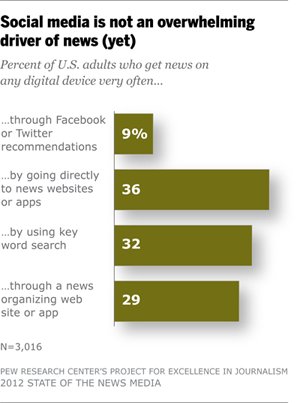
Earlier this summer, we reached out to a number of news organizations to see what they’ve been seeing in recent months. Take The New York Times, for instance. In early 2011, the Times was typically seeing 50 to 60 percent of its visits come from people starting at the homepage of nytimes.com. More recently, that number had dropped a bit, with 48.6 percent of site visits starting there in March. Search engines drove 17.1 percent of traffic to the newspaper, and social is still just a blip: 3.1 percent of New York Times traffic came from Facebook, and 1 percent from Twitter.
....More from Nieman Journalism Lab
Tuesday, August 14, 2012
Groovideo Launches Mobile App To Easily Create Awesome Group Videos
http://techcrunch.com/2012/08/13/groovideo/
Ryan Lawler on TechCrunch
Ryan Lawler on TechCrunch
The mobile video space is heating up, as a number of startups have launched to help users create and share interesting videos with one another. To date, most have been limited to individual users uploading videos and posting them to other social networks like Twitter and Facebook. Maybe they can add filters, maybe automatically edit their videos and stitch them. But the idea of “social” video has been mostly limited to “Here, social friends and followers — watch my video.”
Groovideo has a different idea for how to make videos social, by letting users create awesome content together through its mobile and web apps. Groovideo works like this: Users invite their friends to contribute to videos, each shoot their own short clips, which they upload to Groovideo’s servers, and the startup automatically stitches them all together.
More on TechCrunch
Thursday, August 2, 2012
Magid Research: Smartphones, Tablets Firmly Established As Mainstream Devices; Growth Remains Rapid
The latest large-scale national study from Frank N. Magid Associates looks at key mobile trends, behaviors, and activities. It shows that a majority of all mobile consumers and 76% of those under 44 now own smartphones. More important, these devices are becoming the preferred way of accessing a wide variety of content including social media, news, weather, gaming, and video — including full-length TV and movies. “There’s no such thing as distinct mobile content anymore,” said Tom Godfrey, Magid’s executive director of mobile strategy. “What publishers and advertisers have to realize is that a majority of all ‘Web’ content in the next 12 to 18 months will be consumed on a mobile device — and that it must be accessible and optimized.”
Tribune sponsored a robust section on consumer attitudes and behavior in local media and has made it available for free download to I-Facts subscribers. This section finds that local publishers are well positioned to gain tablet owners’ trust. Consumers prefer local news sources to national ones by a 2-to-1 margin overall, and local has a 3-to-1 advantage on specific criteria as credibility, reliability, and timeliness. Andy Vogel, senior vice president for digital and mobile with Tribune Co., said: “When it comes to content, consumers trust local news sources, and that that trust rubs off to local advertisers as well.” 
Download your copy at http://magid.com/magid-mobile-study The full report is $6500 and includes a customized in-person presentation. For additional questions or to purchase, please contact Tom Godfrey at tgodfrey@magid.com.
Monday, May 21, 2012
Microsoft's so.cl - next extension for metro design

File this in the "we-try-it-out-so-you-don't-have-to" category. So.cl is a derivative social network that may be useful to students, but it won't fly elsewhere.
Over the weekend, Microsoft opened to the public an experimental social network called So.cl. It's a mix between Google+ and Storify. Users are encouraged to search for information about a particular topic, then compile the best results - textual content, images and videos - into a single post. So.cl, which launched in beta at the end of last year, is initially targeted to students. It may end up being useful to that market, but it's unlikely to get traction as a mainstream social network. Here's why...
via readwriteweb.com
Friday, May 11, 2012
Missouri tests new boundaries on citizen joirnalism
Down with citizen journalism!
Long live citizen journalism!
Remember the passionately earnest debate about whether citizens manning the keyboards were either the future or end of journalism?
I’m not certain exactly when the debate’s embers went cold, but the first entry under Google search is a Wikipedia article, most of which was written in the previous decade, and the next two entries go back to 2006 and 2005. A fitting capstone is what’s happened at The Columbia Missourian, produced by students and staff at the Missouri School of Journalism. The Missourian – a pioneer advocate for citizen journalism — has finally integrated community contributions onto its main site after keeping them in a ghetto for seven years on a site called MyMissourian. (The integration is actually only about 90% complete. Reader contributions are still kept antiseptically separate from staff work — on pages under a READERS tab, and they still have to go through a gate-keeping editor.)
So, has citizen journalism won?
One argument-ending answer is this recent contribution — video, photos and text — to The Missourian on “storm chasing” by community contributor Dustin Mazzio, It’s a compelling package that any site would die for. The most skilled regular-issue journalist writing a third-person account could never match what Mazzio produced (“We could feel the inflow as well as see the wind blowing across the crops in front of us, sucking what it could up into the storm”). Mazzio is a professional too — a storm chaser who tracks storms and helps people caught in them.
In every community there are scores, hundreds, of people who have special expertise like Mazzio, and if they were mobilized could give a whole new face to community journalism.
There will always be room for regular journalists, who have been trained in the craft of finding information and the art of fashioning it into narratives that may not be as gripping as Mazzio’s first-person story but can throw a searchlight on community problems that need fixing.
There’s ample room for both, and any site will be improved by having both. Clyde Bentley, a professor at the Missouri School and founder of MyMissourian, told me: “The traditional media, when stripped to the bones, must maintain its role as the eyes of the public on government and civic life. While dispassionate government coverage is often boring, it is vital to society. What citizen journalism can do, when included in a traditional outlet’s mix, is provide some of the softer side of news that takes the edge off of the daily dose of meetings and mayhem.”
But what about going further and putting these two forces together at the community level? There can be a synergistic 1 + 1 = 3. A site that can do that will attract readers and advertisers who want to reach them.
Take health care. But that’s a national issue, isn’t it? Or is it? People don’t go to Washington, D.C., to see their doctor, get an MRI or to be hospitalized. Add up all those local activities and you get the ever-growing $2.6 trillion annual bill for health care. What’s worse is that all these costs vary wildly from community to community and for no logical reasons. Imagine if hyperlocal sites would tell the story of health care in their community – documenting whether it was more or less costly than the average (with adjustments for regional cost of living)?
This is, to be sure, a complex story. But it could be put together if professional and citizen journalists could tackle it from different angles.
The first place to go would be the local Accountable Care Organization, a voluntary group of doctors, hospitals and other providers who collaborate with the goal of improving the quality of care of Medicare patients while also eliminating unnecessary expenses, with all parties sharing in the cost savings. ACOs, part of Obamacare, focus on Medicare because this federal service accounts for 20% of all health costs, and it covers the fast-growing senior population. (Washington Post Wonkblog staffer Sarah Kliff’s reporting on this issue is a great resource to send hyperlocal editors in the right direction.)
The editor of a local site can get the ball rolling by finding which providers are on the local ACO, and inviting them to contribute to a new section that could be titled “Our Health Care Bill for Seniors.” Questions to put to ACO members:
- How can ACOs improve the quality of care – in doctors’ offices and at hospitals
- How do we know that cost cutting won’t include cutting into quality?
- If the ACO works, how much will it save in our community?
- Will some of the savings be invested in improving care locally?
- Do average citizens have a real voice in ACOs?
These are questions to which seniors, and their children and other relatives — indeed the entire community — will want to know the answers. These answers will make great stories for the local website.
It’s possible that some communities don’t yet have an ACO. If not, the website editor should find out why. Is the organization being boycotted by one or more providers who don’t like the rules set up by the feds? If the answer is yes, then the editor can ask the boycotter to explain its action, and get reactions from other local parties. So either way, there’s a story – and if there’s no ACO because it’s being boycotted by one or more local providers, that could be a big story with ramifications for both quality and cost of care.
This is just one example of how citizen journalism can be reinvented to help communities not only become better informed but better places to live – and get quality health care at an affordable cost. Education reform – which is not far behind health care in local importance – is another. The list could go on.
The question is, are community sites ready to take the lead in reinventing citizen journalism to produce a 1 + 1 = 3?
Tom Grubisich authors
The New News column for Street Fight. He is editorial director of LocalAmerica, which is developing a Web site to rank communities on their livability across 20-plus categories. The rankings will be dynamic, going up and down daily as they are updated through a combination of open data, journalism and feedback from local experts and users of the site.
Image courtesy of Flickr user Keith Williamson.
***
Discuss topics like this at Street Fight Summit West. Learn more and buy your ticket today!


Monday, May 7, 2012
Mobile Is the Gateway to Small-Business Owners, SMBs
Nearly all small-business IT companies purchase smartphones for employees
In March 2012, marketing agency Cargo andInc. Magazine found the majority (52%) of US small-business owners felt companies did not market to them effectively. Along similar lines, 45% said companies made little effort to understand their business and 43% said B2B marketers did not understand their individual needs as small-business owners.

Part of the problem may be that the small-business audience is widely diverse. It comprises business and service owners in industries across consulting, retail, food service, agriculture, technology and more. And even at the industry level, small-business owners’ needs are highly individualized and easily reprioritized as owners juggle their marketing, operations, sales and financial responsibilities.
“When you look at the core needs and challenges that [small] business owners are facing, they’re time-starved, and they’re not the type of people sitting in a building behind a computer all day,” said American Express OPEN’s Scott Roen, vice president of digital marketing and innovation, in an April 2012 interview with eMarketer. “They’re out front, working with their customers and employees, so they’re inherently mobile in nature.”
More at eMarketer.... http://www.emarketer.com/Article.aspx?R=1009025
Monday, April 30, 2012
Untitled
Learn more about the science of success with Heidi Grant Halvorson's HBR Single, based on this blog post.
Why have you been so successful in reaching some of your goals, but not others? If you aren't sure, you are far from alone in your confusion. It turns out that even brilliant, highly accomplished people are pretty lousy when it comes to understanding why they succeed or fail. The intuitive answer — that you are born predisposed to certain talents and lacking in others — is really just one small piece of the puzzle. In fact, decades of research on achievement suggests that successful people reach their goals not simply because of who they are, but more often because of what they do.
1. Get specific. When you set yourself a goal, try to be as specific as possible. "Lose 5 pounds" is a better goal than "lose some weight," because it gives you a clear idea of what success looks like. Knowing exactly what you want to achieve keeps you motivated until you get there. Also, think about the specific actions that need to be taken to reach your goal. Just promising you'll "eat less" or "sleep more" is too vague — be clear and precise. "I'll be in bed by 10pm on weeknights" leaves no room for doubt about what you need to do, and whether or not you've actually done it.
2. Seize the moment to act on your goals. Given how busy most of us are, and how many goals we are juggling at once, it's not surprising that we routinely miss opportunities to act on a goal because we simply fail to notice them. Did you really have no time to work out today? No chance at any point to return that phone call? Achieving your goal means grabbing hold of these opportunities before they slip through your fingers.To seize the moment, decide when and where you will take each action you want to take, in advance. Again, be as specific as possible (e.g., "If it's Monday, Wednesday, or Friday, I'll work out for 30 minutes before work.") Studies show that this kind of planning will help your brain to detect and seize the opportunity when it arises, increasing your chances of success by roughly 300%.
3. Know exactly how far you have left to go. Achieving any goal also requires honest and regular monitoring of your progress — if not by others, then by you yourself. If you don't know how well you are doing, you can't adjust your behavior or your strategies accordingly. Check your progress frequently — weekly, or even daily, depending on the goal.
4. Be a realistic optimist. When you are setting a goal, by all means engage in lots of positive thinking about how likely you are to achieve it. Believing in your ability to succeed is enormously helpful for creating and sustaining your motivation. But whatever you do, don't underestimate how difficult it will be to reach your goal. Most goals worth achieving require time, planning, effort, and persistence. Studies show that thinking things will come to you easily and effortlessly leaves you ill-prepared for the journey ahead, and significantly increases the odds of failure.
5. Focus on getting better, rather than being good. Believing you have the ability to reach your goals is important, but so is believing you can get the ability. Many of us believe that our intelligence, our personality, and our physical aptitudes are fixed — that no matter what we do, we won't improve. As a result, we focus on goals that are all about proving ourselves, rather than developing and acquiring new skills.Fortunately, decades of research suggest that the belief in fixed ability is completely wrong — abilities of all kinds are profoundly malleable. Embracing the fact that you can change will allow you to make better choices, and reach your fullest potential. People whose goals are about getting better, rather than being good, take difficulty in stride, and appreciate the journey as much as the destination.
6. Have grit. Grit is a willingness to commit to long-term goals, and to persist in the face of difficulty. Studies show that gritty people obtain more education in their lifetime, and earn higher college GPAs. Grit predicts which cadets will stick out their first grueling year at West Point. In fact, grit even predicts which round contestants will make it to at the Scripps National Spelling Bee.The good news is, if you aren't particularly gritty now, there is something you can do about it. People who lack grit more often than not believe that they just don't have the innate abilities successful people have. If that describes your own thinking .... well, there's no way to put this nicely: you are wrong. As I mentioned earlier, effort, planning, persistence, and good strategies are what it really takes to succeed. Embracing this knowledge will not only help you see yourself and your goals more accurately, but also do wonders for your grit.
7. Build your willpower muscle. Your self-control "muscle" is just like the other muscles in your body — when it doesn't get much exercise, it becomes weaker over time. But when you give it regular workouts by putting it to good use, it will grow stronger and stronger, and better able to help you successfully reach your goals.
To build willpower, take on a challenge that requires you to do something you'd honestly rather not do. Give up high-fat snacks, do 100 sit-ups a day, stand up straight when you catch yourself slouching, try to learn a new skill. When you find yourself wanting to give in, give up, or just not bother — don't. Start with just one activity, and make a plan for how you will deal with troubles when they occur ("If I have a craving for a snack, I will eat one piece of fresh or three pieces of dried fruit.") It will be hard in the beginning, but it will get easier, and that's the whole point. As your strength grows, you can take on more challenges and step-up your self-control workout.
8. Don't tempt fate. No matter how strong your willpower muscle becomes, it's important to always respect the fact that it is limited, and if you overtax it you will temporarily run out of steam. Don't try to take on two challenging tasks at once, if you can help it (like quitting smoking and dieting at the same time). And don't put yourself in harm's way — many people are overly-confident in their ability to resist temptation, and as a result they put themselves in situations where temptations abound. Successful people know not to make reaching a goal harder than it already is.
9. Focus on what you will do, not what you won't do. Do you want to successfully lose weight, quit smoking, or put a lid on your bad temper? Then plan how you will replace bad habits with good ones, rather than focusing only on the bad habits themselves. Research on thought suppression (e.g., "Don't think about white bears!") has shown that trying to avoid a thought makes it even more active in your mind. The same holds true when it comes to behavior — by trying not to engage in a bad habit, our habits get strengthened rather than broken.
If you want to change your ways, ask yourself, What will I do instead? For example, if you are trying to gain control of your temper and stop flying off the handle, you might make a plan like "If I am starting to feel angry, then I will take three deep breaths to calm down." By using deep breathing as a replacement for giving in to your anger, your bad habit will get worn away over time until it disappears completely.
It is my hope that, after reading about the nine things successful people do differently, you have gained some insight into all the things you have been doing right all along. Even more important, I hope are able to identify the mistakes that have derailed you, and use that knowledge to your advantage from now on. Remember, you don't need to become a different person to become a more successful one. It's never what you are, but what you do.
Heidi Grant Halvorson, Ph.D. is a motivational psychologist, and author of the new book Succeed: How We Can Reach Our Goals (Hudson Street Press, 2011). She is also an expert blogger on motivation and leadership for Fast Company and Psychology Today. Her personal blog, The Science of Success, can be found at www.heidigranthalvorson.com. Follow her on Twitter @hghalvorson
via blogs.hbr.org
Wednesday, March 14, 2012
Newspapers:The good, and the future of journalism, part one
At the beginning of March, California’s Los Angeles Times joined a scrum of US newspapers that decided paywalls would be the press’ salvation. But the mighty Pulitzer Prize-winning paper is no longer the press it once was.
Starting in the sixties and peaking in the nineties and early 2000s, the Los Angeles Times would win a clutch of journalism’s most prestigious awards, but then came the ‘deals from hell’ and the paper became a sinking ship. Heads rolled and editors left as the men in suits ruthlessly cut jobs at the paper to safeguard investor interests.
“I've been trying for days to quit the Times, but I cannot seem to do it. In the first place, every time I announce I'm leaving, a more senior editor ups and quits and grabs all the attention, and, in the second place, I do not know anymore who my editor is, who the editor is, who the publisher is, and who owns the company. I think it's the Chicago Tribune, although that might not be the case, either, by the end of the day, since the paper is for sale, or being auctioned,” writer Richard Cohen wrote in a column for Slate.
“I walk the halls with my resignation in my hands. It is a brief document, rather nicely written, I think, but either I cannot find anyone to read it or those who do simply shrug, say something like, ‘Get in line,’ or, because they are in the Internet or TV section of the company, cannot read at all. I mean, they're functionally literate, if words like ‘functionality’ can be considered literate, but they never get the meaning of things. All they ever say is, ‘Reboot, reboot’.”
But let’s not get ahead of ourselves here. Good parables like this should be told from the very beginning, because they serve as exemplars of how journalistic excellence can be screwed by greed. Once upon a time many of the great American newspapers were owned by private families.
The New York Times, for example, is still run by the offspring of Adolph Ochs, an intellectual-cum-refugee-cum-printers apprentice who ended up buying the paper in 1896. The Ochs Sulzberger family is said to be traditional, and treat The New York Times as the clan’s “reason to exist, initiating younger members in its ways and holding gatherings to discuss it”.
Similarly, the LA Times became successful under the editorship of Harrison Gray Otis in the 1800s. After his death, a family – the Chandlers – were the newspaper’s publishers for generations. The sixties were a golden era for the newspaper when Otis Chandler believed that the newsroom was "the heartbeat of the business”. This ideal saw the publisher reinvest in quality journalism, bagging four Pulitzers, more than it had won in almost a hundred years.
But trouble started brewing in 2000 when the Chandlers decided to sell their centurial company the Tribune Company for $8.3-billion plus some cash, stocks and a few seats on the board. Respected media critic for The New Yorker, Ken Auletta, kept a careful eye on the deal saying that initially the Times’ newsroom in Los Angeles welcomed the new owners, but that this enthusiasm soon gave way to embarrassment.
The reason for the shame was “a special edition of the Times’ Sunday magazine devoted” to the opening of the Staples Centre, a sports and entertainment arena with which the newspapers’ publishers had negotiated a profit-sharing plan. “The arrangement, which was kept secret from the paper’s editor until shortly before publication, gave Staples half the advertising revenues for this supposedly independent journalistic enterprise. The Times and its top management had been humiliated,” Auletta wrote.
Tension grew between the Los Angeles Times’ editor, John S. Carroll, and the new owners. Eventually the newsman who had helped the newspaper win 13 Pulitzer Prizes left in 2005. Caroll confided in Auletta that he was tired of the Tribune Company’s “incessant cost-cutting”.
“He believed that, on the contrary, investing in the newspaper would eventually produce higher profits, which was what the company eagerly sought, and that cutting costs, while it would temporarily improve the bottom line, would erode the paper and might someday destroy it. Carroll and the Tribune Company had been arguing about these issues for five years. The resolution would now be left to his successor.”
That successor was Dean Baquet who was Carroll’s second-in-command, but he was forced out very soon after defying orders from the Tribune’s money-men to cut costs by cutting jobs. In the five years since Tribune took over, the Times had chopped the paper’s talent by over 20%. Baquet said no more and was out the door, and in came James O’Shea. No prizes for guessing what happened to O’Shea. He left two years later in 2008 after refusing to slash the newsroom’s budget. With the revolving editorial door turning non-stop, the Los Angeles Times’ circulation plummeted.
However, O’Shea would get his own back by writing a book about the Tribune Company called The Deal From Hell: How Moguls and Wall Street Plundered Great American Newspapers. O’Shea wrote: “Like a lot of people at the time, I was willing to try something, anything, other than what we were doing, which was to just keep cutting costs as the products became less and less appealing to our readers.”
When it comes to laying blame for the destruction of papers like the Los Angeles Times, O’Shea is more than frank. “The lack of investment, the greed, the incompetence, corruption, hypocrisy and downright arrogance of people who put their interests ahead of the public’s are responsible for the state of the newspaper industry today,” his book reads.
More pain was pending for the Los Angeles Times, and it arrived in December 2007 in the form of a foul-mouthed, brutish real estate billionaire called Sam Zell. Like many of the moguls who destroy media companies, Zell had never owned a newspaper in his life, but this didn’t deter him from setting his sights on the Tribune.
Photo: Sam Zell. REUTERS/Fred Prouser.
A lack of media experience only served to embolden Zell who positioned himself as an “expert” in journalism from the get-go. “I’m sick and tired of listening to everybody talk about and commiserating about the end of newspapers. They ain’t ended. And they’re not going to be,” Zell lamented at a press conference to announce the deal, which he labelled “a very low-risk investment”.
Zell’s master plan was to put himself at the helm of the company and take the Tribune Company private with the help of an employee stock purchase plan. However, unlike all his real estate deals, Zell didn’t risk much of his own money, although he did share the risk of the take-over with all the company’s employees. Very soon Tribune was $13-billion in debt.
And then there’s the management “talent” Zell brought to the party. There are wonderful anecdotes about the “talent” Zell hired to help run his new media company. People like Randy Michaels who shortly after the Zell buy-out tried to impress his new colleagues at Tribune by offering a waitress at a hotel $100 to show him her breasts.
The Tribune Company went broke almost a year to the day after Zell had acquired it. But Zell did make news for helping create what is the biggest bankruptcy in US media history. These and other debacles that have beset US journalism are part of the reason why some media are eschewing the “attraction” of public listings and bonehead management like Zell and Michaels to create non-profits. The other reason is that good investigative journalism has been seriously affected by the recession and the fall-out from journalism that serves the church of the shareholder.
ProPublica is a sterling example of this. Enabled by an endowment from Golden West Financial, some of those fine folks who gave the US the subprime crisis, ProPublica writes big, important stories and gives them away to the likes of The New York Times for free. The outfit is run by a journalism supremo, one Paul Steiger, a former Wall Street Journal senior editor whose tenure there realised 16 Pulitzer Prizes.
But let’s go back to the Tribune, the owners of the Los Angeles Times, a company that former editor O’Shea says has leaders that put profits before Pulitzers. "Instead of developing strategies to produce the kind of content that would protect their most important asset — the public trust — they depreciated it like an aging Linotype."
Since Tribune declared bankruptcy in December 2008 it has racked up well over $233.3-million in legal fees, after a class action suit was brought against the company’s employees because of Zell’s “very low-risk investment”.
Last December the Los Angeles Times lost yet another editor who, after cutting the paper’s staff from 900 to about 550, could take no more. Sam Zell remains one of the richest men in the US and made the Forbes’ rich list yet again last year with a net worth of $4.7-billion.
And, the Los Angeles Times’ pay wall plans? Do you think this is going to turn things around for the paper?
Ask yourself whether the Los Angeles Times is the kind of newspaper you’d invest in so that you might read it on your iPad? We both know the answer to that question. DM
[The next instalment looks at those good guys of journalism, the Guardian. Unlike other newspapers whose profits are sucked out of operations by shareholders, The Guardian reinvests profits to “sustain journalism that is free from commercial or political interference”.]
Read more:
- Sam Zell Blames Tribune Failure on 'Greedy' Journalists in Forbes.
- Tribune Paid Bankruptcy Advisers $233 Million Since Filing for Protection in Bloomberg.
- No Exit – One man's desperate attempt to quit the Los Angeles Times by Richard Cohen in Slate.
- Los Angeles Times joins the crowd, erects pay wall for the news online in The Christian Science Monitor.
Photo: The vaulted gates to the LA Times. REUTERS/Fred Prouse.


Monday, March 5, 2012
Procrastination is Essential to Innovation
This post was co-authored with Bob Moesta, Managing Partner of The Re-Wired Group in Detroit. While it's written from my perspective, he was central to the development of the idea.
"How's your book launch coming?" Bob asked me.
"Ugh. I don't want to talk about my book. Can't we just dive into working on another post about progress?" I said, trying to avoid my towering pre-publication checklist.
"Sure, Whitney. But if you're going to write about progress, you might want to make some."
Okay. Bob didn't actually say that, but he could have. Six months before publication, I found myself skittering off to new ideas rather than attending to the task right in front of me. Why was I procrastinating?, I wondered. Writing a book has been on my bucket list for years. I knew how important it was to have a successful launch, yet here I was doing nothing.
So with Bob's help, I started to analyze what was happening within the framework of our theoretical Equation of Progress. We would examine my stalled plans in order to better understand how people make progress, and more specifically, what leads us to innovate.
We had hypothesized that progress could only be made if the push of a situation (a frustration or problem to be solved) and the pull of an enticing new idea were greater than the forces holding us back — our allegiance to past behavior (the status quo) and anxiety.
Certainly, I had experienced a "pull" to write the book. Dare, Dream, Do was inspired by my interactions with people who weren't sure they had a dream, or worse, who didn't believe it was their privilege to dream. And there was obviously a "push" because I finished writing the book. Deadlines are good that way. But the prospect of now tackling a lengthy punch list — build a website, create a speaker's sheet, film a speaker's reel, record an audio Q&A, finalize/plead for blurbs, finalize copy edits, write an e-book to accompany the book — obscured my vision of a future where readers would hold the book in their hands and be inspired to dream. The eventual payoff of completing these tasks wasn't immediately enticing enough to overcome my present inertia, i.e. allegiance to the status quo. No wonder I wasn't making progress.
That all changed when anxiety kicked in about at four months to pub date. I had always thought of procrastination as a bad actor, anxiety even worse. But in analyzing what I thought were merely stall tactics, I've come to realize that the anxiety caused by procrastination is actually a critical component to innovation. Research supports this. Anxiety, in the right quantities, can propel us forward. According to the Journal of Management, NASA scientists and engineers found that performance increases as deadlines shorten, but when the deadlines became too short, performance declined. Dr. Ellen F. Weber, award-winning founder of Mita Brain Center, states: "while frustration or fear can flood the brain with cortisol, if anxiety is managed properly, anticipation can produce that feel-good dopamine that primes the pump of progress, or innovation." In other words, as the deadline neared, my apprehension around the to-do list actually wasn't just outweighed by the pull of the commitments I'd made to my editor, publicist, and to myself, the anxiety per se helped increase the pull.
The innovations, or newly introduced ideas and methods, that have emerged from my anxiety around the book launch include:
1) View the book as a product. I realized my anxiety was caused, in part, by the unfamiliar experience of launching a book. By reframing it as being analogous to launching a business, I talked myself down. I've never published a book before, but I have incubated businesses. When you're overwhelmed by a new project, look to your past for similar problems you've already solved. Just as a business model is required to maximize the reach of a simplifying technology, so too is a business model required to maximize the reach of a book. Looking at the book as a product has helped me lock into great ideas and energized my efforts.
2) Write my way through the launch. Just as scientists meticulously record daily findings to ensure that each experiment is replicable and accurate conclusions are drawn, I realized I could write about my experience of publishing a book. Dissecting the process and hoping that my experience may be helpful to others has turned out to be powerful motivator (and a source of content for my blog). When you can zoom out and view your experience in the abstract, you create the necessary distance to be objective about your own performance. In essence, you give yourself a general's panorama of the battlefield rather than the limited view of a foot solider. Vision is essential for innovation.
3) Collaborate — and accept the help of others. Though I've written about the importance of collaboration, I struggle to do it well, and even more so to receive help. The anxiety factor has pushed me to reach out, something I might not have been willing to do previously. I've found fantastic partners who have enriched my efforts with their resources and granted me access to specialized knowledge that will strengthen my "product." Sometimes anxiety can be the tool that forces us past imagined boundaries into a brave new world of possibility.
As I have begun to innovate, to introduce new ideas and ways of doing things, frustration and anxiety have given way to the anticipation of my book selling. In hindsight, it's easy to think that progress is a simple left to right beeline, rather than something approximating a Wild West duel between you, and you. It's also tempting to glorify "push" (the problem to be solved) and "pull" (the exciting new idea) as the forces of progress we laud in entrepreneurs. But sometimes your weaknesses (procrastination and anxiety) may actually be the "red-hot coal stuck in the throat" that summons your superpowers. Or as Bob Moesta writes, "The moment of struggle is the defining act of innovation." So, the next time you want to move your business or you forward, consider the role all four variables play, but then look to the bottom line: put your anxiety to work and innovate.
To think more about the four variables involved in progress, consider reading:Push
Why I'm Glad Sheryl Sandberg Isn't On Facebook's BoardPull
The Essence of a Great Presentation
Allegiance to the Past
Battling Entitlement, the Innovation KillerAnxiety
The Long of Coming Up Short
via blogs.hbr.org
Friday, February 24, 2012
How to Turn an Obstacle into an Asset
A popular post on this site, Nine Things Successful People Do Differently, provides a fabulous summary of what makes the difference between those who succeed and those who don't. But, in our experience, it misses one really important "thing': Successful people habitually turn obstacles into assets.
People who succeed at work and in life believe and act as if "everything is a gift." Well, maybe not every single thing imaginable. But assuming that everything is a gift is a good way of looking at the problems and surprises you'll encounter in any endeavor, such as, for example, in getting a new venture off the ground, obtaining buy-in with your boss, or launching a new product line in an ultra-competitive market.
Why should you react to a problem with gratitude, whether you are trying to start a business or create anything else? There are a number of reasons.
First, you were going to find out eventually what people did and did not like about your idea. Better to learn it as soon as possible, before you sink more resources into the idea, venture or product line, etc.
Second, the feedback could take you in another direction, or serve as a barrier to your competitors. You thought you wanted to open a restaurant, but a quick survey told you potential customers thought the area was saturated. But more than a few of them said they would love a place that simply had ready-to-go take out to heat up at home.
Third, you got evidence. True, it was not what you were expecting or even wanted, but that still puts you ahead of the person who is just thinking about doing something (like opening a restaurant in your neighborhood.) You know something they don't, and that is an asset. You are ahead of the game.
But what if it's really bad news. It's a disappointment. You were absolutely certain that your boss would approve your idea for a new software program, and she said no in a way that is still echoing down the corridor. No reasonable person can define what you've encountered as anything but a problem, and most people will try to solve the problem. ("Maybe she will like the idea if I go at it this way instead.") That's fine if you can. The problem has gone away and, again, you've learned something that others might not know. (The boss hates Y, but she loves Z.)
But what if you can't solve it? (She hated "Z," too.) Accept the situation to the point of embracing it. Take as a given that it won't ever change, and turn it into an asset. What can you do with the "fact" that it won't ever change? Maybe it presents a heretofore unseen opportunity. Maybe you build it into your product or service in a way that no competitor (having not acted) could imagine. Could you do it on your own? Could you take the idea to a competitor and use it as your calling card to look for the next job? Instead of resisting and lamenting it, treat it as a gift and turn it to your advantage.
For a quick exercise showing that this is easier than you think, take a sheet of paper and divide it into three columns. In the left-hand column, list the obstacles and problems that are keeping you from your goal. Then spend five minutes figuring out as many ways as possible to solve these problems, and list those in the middle column. Show your list of problems and solutions to a friend, and ask them to build on your solutions. When you can't think of anymore solutions, go back to the list of problems in the left-hand column and assume that they can't ever be solved. Now take five minutes with your friend and figure out how those problems could be an asset or an unrecognized opportunity. Put these assets in the right-hand column. Chances are good that, having completed this exercise, you'll turn at least one of your obstacles into an asset.
The thing to remember is this: Successful people work with what they have at hand — whatever comes along — and try to use everything at their disposal in achieving their goals. And that is why they are grateful for surprises, obstacles, and even disappointments. It gives them more information and resources to draw upon.
via blogs.hbr.org
Subscribe to:
Posts (Atom)