From Fast Company - http://bit.ly/xFcjtH
From handshakes to hardware, intimate signals constantly affect us in life. As the world becomes increasingly digital, we are losing many sensory signals that once moved us. Here's what can companies do to reclaim these touching moments.

I’m sure you’ve had the experience of reaching out to shake someone’s hand, only to be surprised by a palm so limp that it feels more like a dead fish than a warm welcome. What was your immediate impression of the person? How, then, did you reassess them? If you thought it indicative of a weak character, you’re onto something.
Some years ago, researchers at the University of Alabama studied 112 male and female students whose handshakes were evaluated by four handshake coders. The coders had received one month of training and practice in shaking hands and evaluating handshakes before the study began. The students, who didn't know their handshakes were being evaluated, had their hands shaken eight times (twice with all four experimenters) and they also completed four personality questionnaires.
Results of the study, led by Dr. William F. Chaplin, showed that a person's handshake is consistent over time and is related to some aspects of his or her personality. Those with a firm handshake were more extroverted and open to experience, and less neurotic and shy than those with a less firm or limp handshake. What strikes me is that we are somehow intuitively aware of this personality evaluation filter, where something as simple as a touch significantly influences our decision-making processes.
Having worked with sensory signals throughout my career, I’ve come to appreciate how the smallest sensory details can have the greatest impact. Take, for example, the sound and feel of opening a bottle of water. You’re at least subconsciously familiar with the subtle click of a breaking seal. However, let’s say you’re in India, where the water bottles open silently. When I heard about the absence of the subtle click, I questioned the safety of the water. Apparently I wasn't alone: I remember reading about a competitive water bottler who took advantage of this, changed the top so that it clicks, and gained a competitive advantage in the water market place. People believe the water is safer.
Signals across almost every aspect of our lives affect us. It’s interesting to note that, as we become increasingly digital, we are losing many sensory signals that once surrounded us. Others, however, often replace these. We’ve come to depend on a whole new set of tones as we key in numbers on an ATM or a cell phone.
In order to investigate just how important our senses are, I initiated a small experiment exploring people’s perception of an unknown brand, based on the type of media where they were introduced to it. I wanted to look at how different media formats convey indirect messages. But, most importantly, I was interested in seeing if the physical presence of a media channel, such as a billboard, would affect a person’s sensory impression of the advertised brand.
More at FastCompany.com
Read more by Lindstrom: We Know What You Want And When You Will Buy It
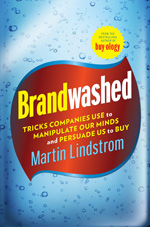 Martin Lindstrom is a 2009 recipient of TIME Magazine's "World's 100 Most Influential People" and author of Buyology: Truth and Lies About Why We Buy (Doubleday, New York), a New York Times and Wall Street Journal best–seller. His latest book, Brandwashed: Tricks Companies Use to Manipulate Our Minds and Persuade Us to Buy, was published in September. A frequent advisor to heads of numerous Fortune 100 companies, Lindstrom has also authored 5 best-sellers translated into 30 languages. More at martinlindstrom.com.

No comments:
Post a Comment